
Plasmids: a history lesson
It all started with insulin

What is a plasmid?
I learned all about plasmids when studying antimicrobial resistance (AMR). All though not all AMR comes from plasmids, most resistance in gram negative bacteria are mediated by plasmids.
Plasmids are circular pieces of DNA that are found outside of the nucleus, that can confer multidrug resistance. These pieces of DNA can be shared between bacteria of the same species or even of different species.

Insulin, the first recombinant DNA drug
Way back when, in a place which seems so innocent and magical, my undergraduate pharmacy class were driven to Indianapolis to see Eli Lilly’s first bio-engineered plasmids making human insulin. That was 1982.
World’s first GMO—GE insulin—approved 35 years ago
The seminal molecular genetic engineering experiment was reported in a 1973 research article by academic scientists Stanley Cohen, Herbert Boyer and their collaborators. They isolated a ringlet of DNA called a “plasmid” from a bacterium, used certain enzymes to splice a gene from another bacterium into that plasmid, and then introduced the resulting “recombinant,” or chimeric, DNA into E. coli bacteria.
Lilly began its clinical trials of this bio engineered human insulin in 1980. Astonishingly, the review and approval took the FDA only 5 months, when the average at that time was 30+ months. This was a new technology, and a new platform and no other drug had every been approved that rapidly. The approval was granted in 1982.
There is no doubt in my mind that bioengineered human insulin made with E coli plasmids was a huge advance. Pork and beef insulin ( from animal pancreas) caused all kinds of problems given long term, including anaphylaxis, and injection site reactions including lipodystrophy, though bioengineered human insulin is not without its issues.
This kicked off an era that within a couple of decades would see recombinant DNA-derived drugs and those made with another biotechnology – monoclonal antibody technology – dominate drug development. Sales are in the hundreds of billions of dollars annually, and recombinant DNA- and monoclonal antibody-derived drugs dominate the top ten sales leaders in the pharmaceutical sector.
However, did that fast track, warp-speed like approval of insulin affect the FDA’s approval of a similar new bio engineered product 40 years later?
Today? Plasmids are ubiquitous, big business and you can order a bespoke plasmid from several companies, made to order. You can order a plasmid that expresses the spike protein at Addgene SARS-CoV2 plasmids
Plasmids for expressing proteins
Until the mRNA technology, plasmids were used to express the PROTEIN, not the intermediate mRNA. (Remember the central dogma of biology - goes one way from DNA to mRNA to protein). Plasmids can be used in mammalian, insect, plant and bacterial or yeast cells. While DNA is easy to make/produce, proteins themselves are not. Biology is much more efficient. These are artificial plasmids, designed to be inserted into another cell, in order for them to produce the protein of interest. Here is a typical, scaled down plasmid used for expressing a protein.
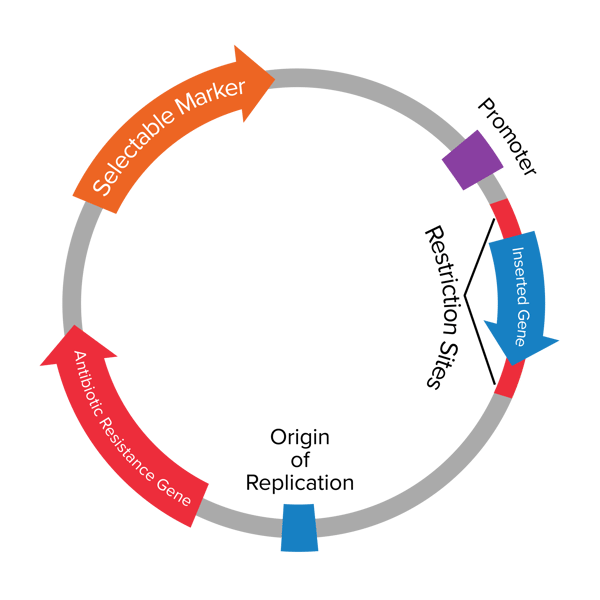
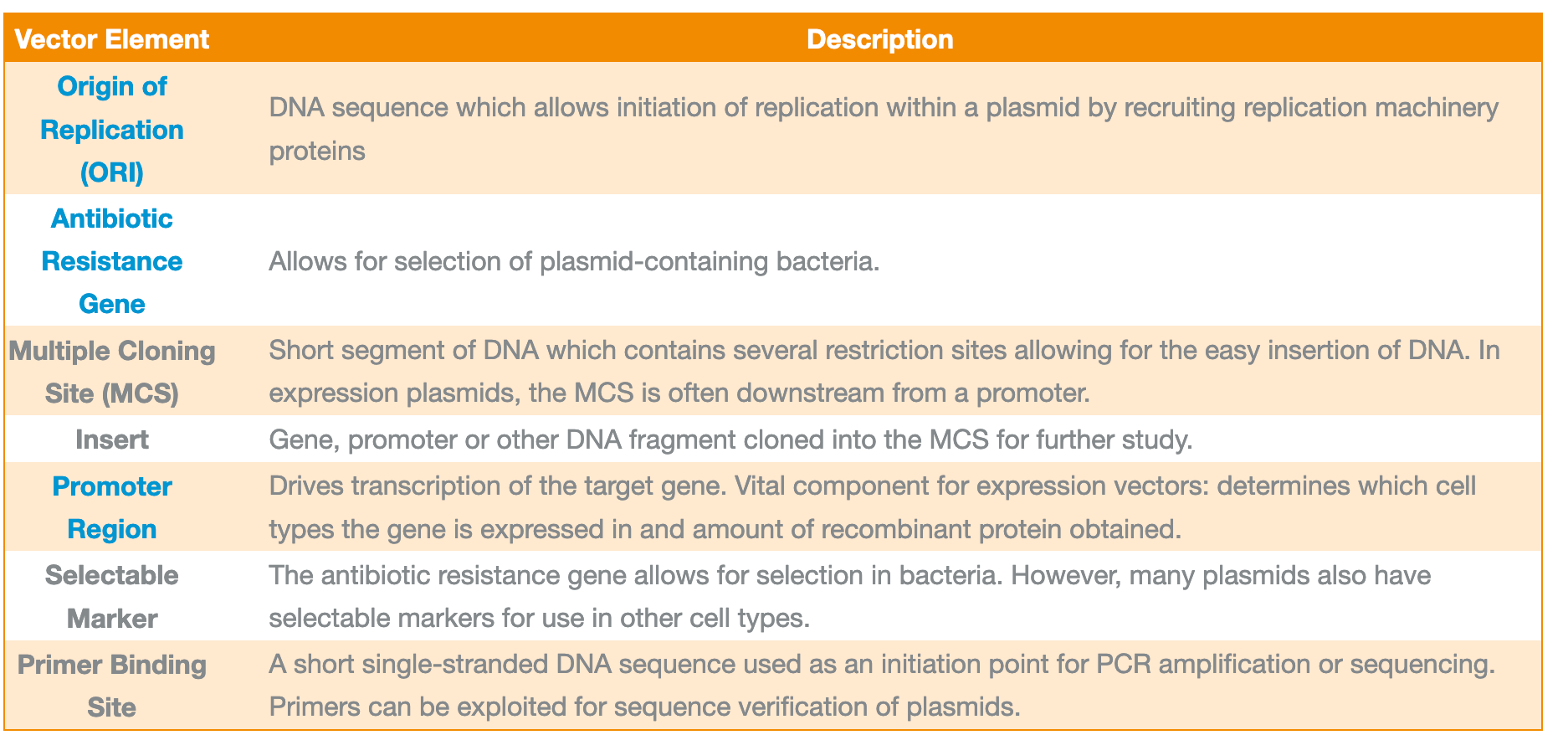
The Pfizer/BioNTech plasmid for the spike protein has an ORI, the antibiotic resistance gene, promoter region, selectable marker and the spike protein DNA. Thus the plasmid is bigger than just the spike protein part.
Plasmids for SARS-CoV2 spike protein production
As far as I can tell, there is no real difference in plasmids designed for protein production, and that designed for just mRNA. The only difference is that you would let the E coli continue multiplying and making more plasmids and expressing the protein encoded by the plasmid. Then you can purify and extract the protein.
Here is a plasmid you can buy to express the delta strain spike protein for pseudovirus production from Addgene and annotated using SnapGene software. delta strain plasmid
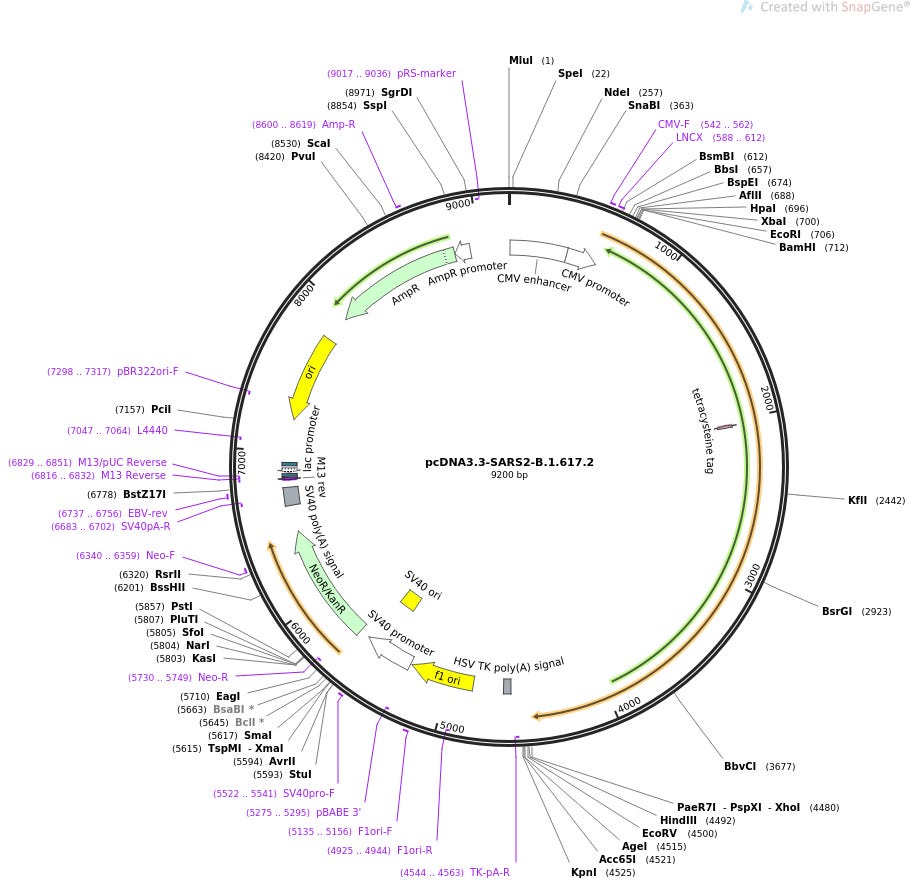
This plasmid also has the SV40 promoter/enhancer/ori and as well a mystery reverse ORF. This plasmid is for mammalian expression and I dont know if it is codon-optimized or not. But it is strange. If anyone can help me here, I’d appreciate it. But the point is, plasmids can be ordered or made for just about any protein you want to study.
If plasmids are used for protein expression, why did we stop at mRNA?
Why couldn’t we have made a protein vaccine? A subunit protein vaccine like Novovax? Maybe without its adjuvant and maybe not just the spike protein, but still.
The genetic revolution started 40yrs ago does not need transfection to develop vaccines. (whether vaccines acheive what we want them to do or if they are safe is another disucssion.) The knowledge and information we have to produce monoclonal antibodies and proteins can be made to a very high purity and specificity.
I believe it would have been comparably as fast to have made a protein based vaccine as it was to make an mRNA vaccine. Methods and analytical techniques were already known and could have been leveraged. So why was the mRNA platform pushed on the West?
The mRNA is newer, with new analytical methodology, requiring in vitro biological potency assessments and multiple issues with the LNPs. Why use a new unproven technology? With the current findings of the DNA impurities, the SV40 promoter and the mystery ORF, mRNA technology appears to be a stealth gene therapy mandated on a large proportion of the Western population.
Who would have thought, that the first plasmids I saw 40yrs ago making insulin would have started the bioengineering revolution that resulted in these mRNA jabs.
It is time for a reassessment. mRNA in LNPs are not equivalent or comparable to other therapies made with the lowly plasmid.
The mRNA plataform is the only "computer ready" plataform, it takes little fidgeting and mathematical equations to change the entire immunogenicity of the desired protein. They had to start mass testing to gather data to "fix" the kinds and bug somewhere I guess.
I abhor mRNA as a vaccine plataform, but I could infer their intent was based on forecasting biological threats, it is the only plataform "fast enough" for aggressive responses against, well, basically almost anything.
The biggest problem of the mRNA lies on its origins, at this point, everyone is aware it was intended as a "cancer vaccine", and it is precisely there the biggest hurdle lies and all the paradoxical effects come from. To get inside the cells without alerting the body, they literally can start "turbo cancer" at any age.
Ironic. A cancer vaccine that can induce aggressice oncogensis.
Based on your interesting writeup, may I ask some follow-up questions/comments, please?
Have you previously ever noticed that the SV40 promoter, or an undeclared ORI, was added by default or accidentally? In reading various articles, it is obvious that the SV40 promoter/enhancer has long been used sort of as a positive control for numerous experiments.
Theoretically, could it have been the case that the SV40 part was during the earlier phase of the Pfizer jab development (Process 2) used as a positive control but then forgotten to take out from their model plasmids? They may argue that "it was all about speed" and that taking out the SV40 part was "just an oversight."
Finally, I would like to encourage everyone who is able to do so to please always sequence the plasmids in question and not merely rely on any (purported) digital description of them alone. Especially since the contamination issue with the Pfizer jabs has made news, it seems to me that presence of any offensive genes etc in the plasmids could easily be erased ONLINE from their DIGITAL description. This would NOT mean that they are absent from the actual/real plasmid. This is a huge safety/security issue that is largely under-appreciated, please see my article in Biosafety& Health: https://pubmed.ncbi.nlm.nih.gov/33015604/. There is a inherent GAP between the physical/biological entity and their digitized/online DESCRIPTION. If someone wanted to, this gap could easily be exploited to ingress changes (additions, deletions) that you can only know if you check both components.
Thank you.