
Reflections after the MAHA Panel Discussion
The MEVI event held March 9, 2026 by the MAHA Institute

1. Introduction
I was dumbfounded when I was asked to contribute to the MAHA panel discussion out of the blue a few weeks ago. I didn’t think it was real at first. I thought I was being scammed, but it was real. I am not normally a person who likes to be on stage or at the centre of something, because I think I will stumble or say something foolish or not quite accurate. I really admire people like Kevin McKernan, Jessica Rose and Nic Hulscher who can speak extemporaneously off cuff with references, studies and the like at their fingertips. Not me.
Thank you MAHA Institute, and especially Justin Santopietro for the invitation. I felt that I had to go in person. I actually felt compelled to go for some inexplicable reason, …. well maybe I now know why.
The Massive Epidemic of Vaccine Injury event was held at the Willard Hotel in Washington DC. I must say that hotel was one of the beautiful hotels I have ever been in. Understated elegance. A hotel with history and weight.
Most of the people there were policy analysis, lawyers, politicians, with some scientists. I have worked in policy myself in the past. And I have learned that without solid science, and an understanding of scientific findings, you cannot really make sound policy. This MAHA panel offered an opportunity where science and policy could meet without the usual filters. I was asked to contribute to the COVID-19 vaccine panel, specifically focusing on the Lipid Nanoparticle (LNP) delivery systems, the physical platform underpinning all mRNA therapeutics.
My goal was to bridge molecular behaviour and policy of the LNPs, to show that we cannot design good regulation for a biology we really haven’t bothered to understand.
2. The Central Question
I want to ensure to those attending of the following:
“If only a fraction of lipid nanoparticles (about 90% on average) result in successful gene expression, what are the rest doing in the body? And how are they metabolized, cleared, or interacting with cell membranes?”
LNPs represent soft matter physics, a field unfamiliar to most working in immunization or regulatory policy or even mot commenting on these therapeutics. I wanted to ask the questions that have yet to be answered, not to invoke more alarmism, but to emphasize more work must be done. That the LNPs are not inert “fat bubbles.” They are dynamic supramolecular assemblies with their own behaviours, thresholds and non-linear effects. This can lead to adverse effects and variable outcomes that we struggle to understand. If our oversight and understanding assumes they are passive, well, that oversight is obsolete.
3. Key Takeaways
These were the points I made
LNPs are biologically active interfaces, not inert carriers.
Batch variability and particle behaviour demand soft matter physics characterization, not small‑molecule assumptions.
Transparency and data access on biodistribution and protein translation are essential to public trust.
Reclassification of LNPs as active agents would align oversight with scientific reality. In fact, the assembly of the 4 lipids plus the modRNA should be considered the “active ingredient” for regulatory analysis.
Better analytics are needed such as proteomics, transcriptomics to map LNP behaviour
I want to clarify one point that may have been misunderstood. It’s not that the components comprising lipid nanoparticles cannot be measured. Of course they can, and they are. We have assays for dsRNA, endotoxin, residual DNA, and every major lipid constituent. The issue is not measurability, but methodology. Because LNPs are dynamic assemblies rather than stable molecules, no single analytical approach captures the full picture. As Kevin McKernan rightly observed regarding DNA quantification, we need orthogonal methods, that is multiple, independent techniques to verify results and avoid analytical blind spots.
And just as important, is measuring behaviour in vivo. Advances over the past few years including single‑cell imaging, proteomics, and real‑time nanocarrier tracking are now making that possible (still need lipidomics!). These emerging tools have shown us how LNPs interact with membranes, remodel in biological fluids, and influence downstream cell signaling. Only by combining composition and behaviour can we truly understand these systems.
4. Changing the Object of Analysis
For more than a century, pharmacology has treated medicines as molecules. Single tidy, fixed, measurable entities that obey linear dose‑response logic (well mostly!). The LNP era broke that paradigm.
LNPs are assemblies, not molecules: collections of thousands of interacting lipids and RNA molecules that reorganize and remodel moment to moment in the body. Their identity emerges from process, not formula. As Cullis keeps saying, LNPs acquire a biological identity when they contact plasma or lymph.
This challenges key assumptions underlying current regulatory frameworks and assessment. Regulatory agencies are still measuring composition when they need to measure behaviour. The pharmacological “drug” effect is not the modRNA itself, or the DNA contaminates but the system event created when these assemblies, a physical entity with surface area and mass, meet living cells.
Although these products are defined as vaccines under regulation and law, this is based on indication, i.e., its primary use. That definition does not account for systems ontology, which requires that LNPs be treated as process‑defined biointerfaces rather than static chemicals. If this is not done, then safety evaluation will remain conceptually blind. We cannot “see” what we do not first name. Transparency is simply honesty in a science that now knows its objects can change while we observe them.
5. Looking Forward
This framing represents a paradigm change, and such changes are always hard to communicate, understand, and integrate into existing frameworks.
Each of the following transitions reflects the move from a 20th‑century pharmacology of stable substances to a 21st‑century science of dynamic assemblies.
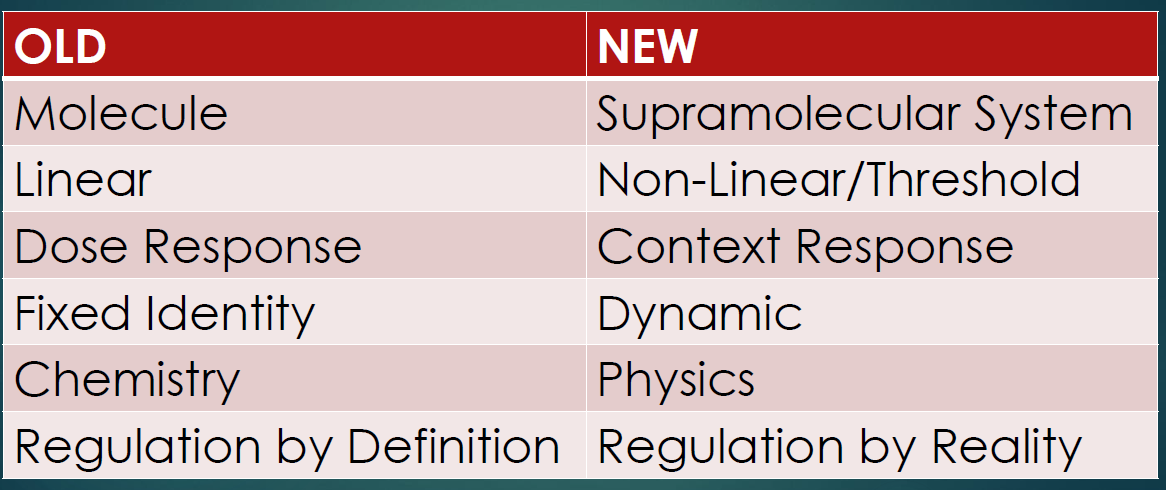
We can’t regulate what we don’t understand, but understanding begins when we name things correctly. I am not sure I was able to clearly communicate these concepts, but hope that this reflection gives everyone an idea of where I see things going.
The modRNA “vaccines” represent 21st century drugs. We need 21st‑century pharmacology and regulation to match.
I kept my rosary in my pocket the entire time. For me, prayer steadies the hand and clears the mind. And it also reminds me that truth‑seeking is not only an intellectual act, but a moral one.
So as always, continue to pray the rosary.
Don't be dumbfounded. Your voice is an important one. You have perspectives on these matters that no one else has.
Keep fighting!
👍