
What the Lancet Review on mRNA Vaccines Misses About the LNPs
Clearance is not silence

Introduction
The Lancet just published an article on the safety and efficacy of the vaccines. It is behind a paywall (of course) but I was able to get a copy (thank you Dr Pelech). The first author is Dr. Anna Blakney from the University of British Columbia (her lab is right beside Cullis’s)
Now Anna Blakney knows lipid nanoparticles. She’s one of the world’s top LNP engineers. She is Tier II Canada Research Chair in Nucleic Acid Bioengineering, MIT 35 Under 35, the works. Her work on saRNA, intranassal formulations, and next-gen LNPs (less PEG, no ultra cold storage) is genuinely impressive. So when she co-authors a comprehensive Lancet review on mRNA vaccine safety and efficacy, it deserves careful reading.
This paper: Safety and efficacy of mRNA vaccines: a mechanistic and public health perspective (Blakney et al., Lancet, June 2026) is very well referenced, clearly structured, well written and represents the institutional consensus. My disagreement isn’t with the scholarship or data quality, it is with the interpretive framework, especially around the LNPs.
The Core Framing
The way I read the paper is that the safety narrative rests these assumptions.
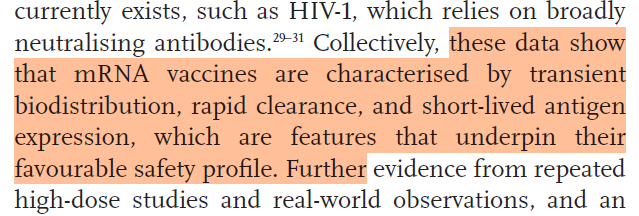
LNPs are transient. Biodistribution studies show mRNA and lipids “clear” within days to weeks.
Clearance equals safety. What’s gone can’t hurt you.
Therefore, the platform is fundamentally benign.
Here’s how they put it:
And with respect to LNPs:
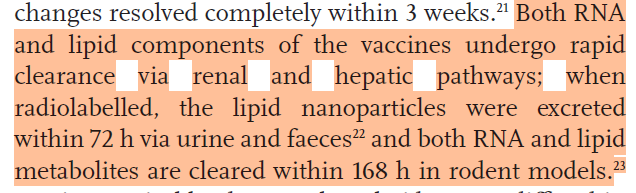
The assumption, always implied, is that LNPs are essentially inert carriers. UPS trucks. They drop off the package and drive away.
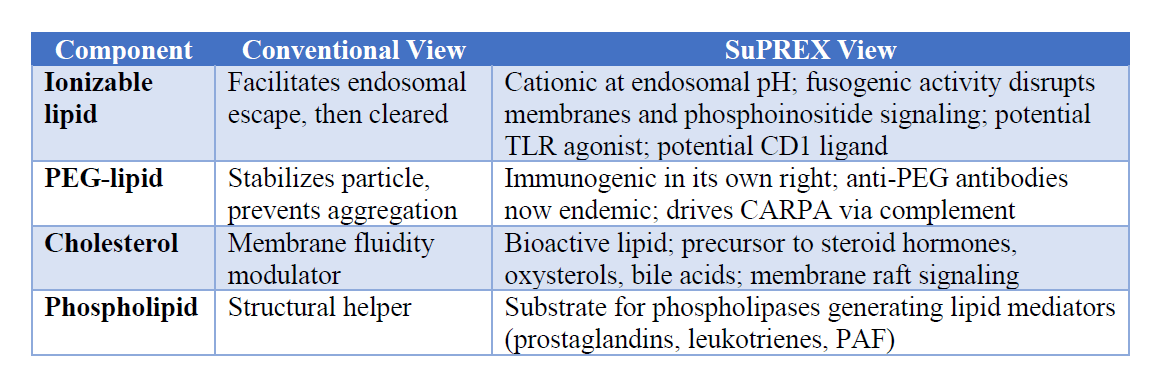
But I maintain they are not trucks. I see the LNPs as supramolecular assemblies (I call them SuPREXes or Supramolecular Process-Defined RNA expression systems). Every component has biological activity, and as a metastable assembly, has emergent behaviour you cannot predict from the individual components. See my substack on this.1

Here is a quick table comparing the two frameworks with respect to the lipid components. However, the SuPREX framing does not treat each of the component lipids (plus the mRNA) as individual molecules, but as metastable supramolecular assemblies.
What the References Actually Show
Dr Blakney really knows the literature and the references she uses are the classics in the field, especially on biodistribution. Papers like Ci et al2, Burdette3 and Kent 4 and the Pfizer non-clinial data.
1. Biodistribution Is Not Just the Injection Site
The paper claims LNPs “remain largely localised to the injection site, with limited distribution to secondary organs, such as the liver, spleen, adrenal glands, and ovaries.”
This is objectively true.
But the SuPREX question is whether the pharmacological cascade initiated during those three weeks such as cytokine storms, immune cell training, epigenetic shifts, lipid activity on cell membranes resolves or or is simply invisible to standard toxicological endpoints.
EDIT: Furthermore, Blakney doesn’t mention the protein corona fomation. LNPs rapidly acquire a coating of host proteins after entering biological fluids, this gives the LNP a “biological identity” and affects cellular interactions, biodistribution, and clearance. That is why the in vivo behavior of LNPs cannot be understood solely from their in vitro manufactured LNPs. There is no iv vitro to in vivo correlation. The protein corona is a dynamic remodeling process which is currently being recognized as a central determinant of LNP and actually all nanoparticle pharmacology, but does not recieve a mention.
2. The Homogenization Problem: Why Organ-Level Biodistribution Misses the Signal
These well done biodistribution studies cited quantify mRNA and lipid levels by homogenizing whole organs and measuring average concentration. An ovary gets ground up, extracted, and you get a number: “low.” A heart gets homogenized, and the signal is below some threshold. This assumes the organ is a bag of liquid and the lipid evenly distributed throughout. The classic pharmacokinetic compartment model.
But Luo et al., in their single-cell pharmacokinetic analysis using SCP Nano technology demonstrated something that upends this entire approach: protein expression is punctate, not diffuse.5
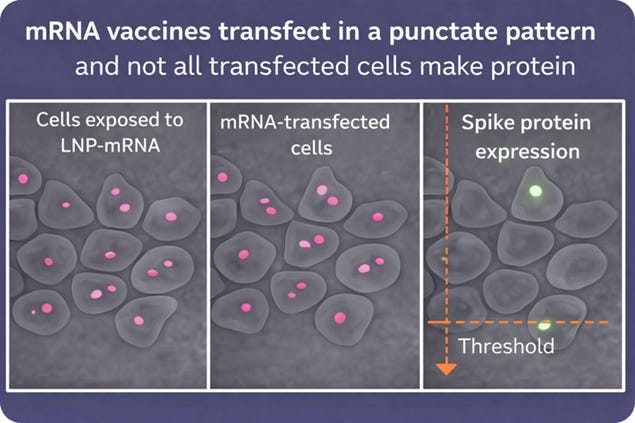
Note: Illustration generated using ChatGPT based on author-provided (me!) scientific concepts and microscopy data
When you track individual cells rather than organ homogenates, you find that a tiny fraction of cells in a given tissue take up massive amounts of LNP-delivered mRNA while their neighbors take up none. A few cardiomyocytes expressing spike at extremely high levels. A handful of ovarian cells transfected with enough mRNA to produce antigen for days.
This single-cell reality isn’t addressed in the review.
3. Heterogeneity Matters
Here is Blakney’s own faculty page6 emphasized characterizing RNA formulations at a granular level.
Yet the Lancet paper treats “the LNPs” as uniform. Real preparations documented by the Berkeley Lab/Genentech collaboration using small-angle X-ray scattering (SAXS) at the Advanced Light Source, is that any given LNP preparation contains a distribution of particle architectures.7 Some LNPs have neatly ordered, closely packed internal structures. Others are disordered blobs. Some encapsulate RNA efficiently. A not insignificant amount are empty, lipid shells with no cargo. Some display PEG on the surface; in others, the PEG is buried and functionally absent.This has direct pharmacological consequences.8 And then there are the blebs. There’s even a dedicated blog.9
Empty LNPs are pure SuPREXes. No antigen. No therapeutic rationale. Just SuPREXes entering the bloodstream and distributing to tissues, with all the immunopharmacology that entails and none of the intended benefit. The paper discusses manufacturing quality control for mRNA integrity and DNA impurities but doesn’t address which fraction of lipid particles actually carry functional mRNA. That fraction determines how much uncontrolled LNP immunogenicity experiment you’re running with every dose. And these issues are not discussed despite her very own post-docs working on these very problems.10 (great paper, BTW).
4. Persistence and Clearance
The paper cites Roltgen et al11 :
mRNA and spike antigens were detectable in ipsilateral axillary lymph nodes for up to 60 days post-vaccination
and frames this positively for geminal centre responses. But under a SuPREX view, that’s two months of spike protein production in immune tissue, with the LNPs’ ionizable lipids doing their membrane-fusing thing in exactly the compartment where immune tolerance decisions are made and potentially related to the IgG4 class-switching they acknowledge later in the paper (from 0.04% to 19.27%—ref 179).
On clearance, the paper’s pharmacokinetic argument rests on (quoting Burdett et al):
“When radiolabelled, the lipid nanoparticles were excreted within 72 h via urine and faeces... both RNA and lipid metabolites are cleared within 168 h.”
A classic pharmacology point. Pharmacokinetic clearance (carbon leaving the body) is not the same as end of biologic effect. For instance, aspirin clears in hours. Its effect on platelet cyclooxygenase lasts the lifetime of the platelet, about 7 to 10 days.
When ionizable lipids fuse with endosomal membranes to release mRNA, they don’t simply vanish. They become part of those membranes as we discuss in our preprint. The lipids integrate into cellular architecture. They’re metabolized into bioactive intermediates such as lysophospholipids, diacylglycerols, free fatty acids, each with their own signaling (pharmacological) properties. Importantly: the tertiary amine head itself shows no metabolism in Burdette. This raises the question if it remains pharmacologically active during its transit like other tertiary amines. Does it interact with amine receptors, transporters, or ion channels? Are they trapped in the lysosomes? I’m not sure we know yet.
6. The Cationic Ghost of LNPs Past
The modern ionizable lipids (ALC-0315 and SM-102) were deliberately designed to be less toxic than the permanently cationic lipids used in many early gene therapy experiments that Blakney herself studied. And by most accounts, they are. Blakney writes:
“Ionisable lipids have consistently shown reduced cytotoxicity and improved tolerability compared with permanently cationic lipids.”
citing Jörgensen et al.12
This is true on one level, the modern ionizable lipids have less toxicity than the permanently charged cationic lipids. However, reduced cytotoxicity does not mean a molecule is biologically inert or pharmacologically silent, and nothing about the structural biology of these amphiphilic molecules suggests that it should be.
In fact, I think Jörgensen’s review provides a more nuanced review than her brief summary suggests. Jörgensen et al devoted substantial attention to unresolved toxicological questions. They even note that biodegradation of current ionizable lipids “does not improve their safety” when synthetic ionizable head-group metabolites remain after ester cleavage.
I think seeing the difference between these 2 classes of lipids, really colours how you see the ionizable lipids. We have that a lot in medicine. Chemotherapy is safer than older chemotherapies. New anticoagulants reduced some risks compared with warfarin but introduced others. “Safer than before” is not the same as “without clinically relevant pharmacology/toxicology.” Benchmarking against a highly toxic predecessor can make meaningful residual pharmacology seem deceptively benign.
The PEG and CARPA Gap
The review discussed anaphylaxis and concludes anti-PEG IgE is unlikely the main trigger. It acknowledges rising anti-PEG antibodies as a reason to replace PEG in future formulations.
“Replacing PEGylated lipids is a priority and addresses the rising prevalence of anti-PEG antibodies, which could accelerate nanoparticle clearance and reduce effectiveness.”
But it stops short of addressing complement activation-related pseudoallergy (CARPA), a well-established clinical syndrome recognized by the FDA and EMA. The mechanism is understood in detail: nanoparticles activate complement through both the classical and alternative pathways, generating anaphylatoxins C3a and C5a, which trigger mast cell degranulation, smooth muscle contraction, increased vascular permeability, and in severe cases, cardiopulmonary collapse. CARPA does not require IgE. It is a pseudoallergy, often clinically indistinguishable from true anaphylaxis (and mostly self-limiting) but mediated by complement, not by prior sensitization. It is usually associated with IV infusions and is a threshold mediated response. Szebeni and colleagues at Semmelweis University 13 have published extensively on this. The porcine model for CARPA is well-validated (CARPA doesn’t happen in mice or rats BTW).
The omission of CARPA is notable in a review co-authored by a leading LNP researcher. Maybe CARPA is thought not to occur due to its IM administration and low dose? But this remains an assumption, since rapid partial entry of LNPs into blood after IM injection can occur and complement activation occurs post mRNA vaccination.14
Please see my substack on CARPA.

LNP Immunogenicity Beyond the mRNA
It is known that LNPs trigger innate immunity through multiple pathways:
Toll-like receptor (TLR) signaling.15 The ionizable lipids, the phospholipid components, and even the cholesterol in LNPs are recognized by pattern recognition receptors.
CD1 and lipid antigen presentation.16 CD1 molecules present lipid antigens to T cells. Ionizable lipids, once metabolized or presented in the context of cellular stress, could generate CD1 ligands. The lipid antigen presentation field has shown that seemingly inert lipids can become immunogenic when presented on CD1.17 An LNP is a bolus of exotic lipids entering antigen-presenting cells. What gets loaded onto CD1? Has anyone looked?
Inflammasome activation.18 Cationic and ionizable lipids can trigger NLRP3 inflammasome assembly, driving IL-1β and IL-18 release. It’s why early cationic lipid formulations were too toxic to use. The modern ionizable lipids reduce this but don’t eliminate it. The paper’s discussion of reactogenicity, fever, chills, myalgia, is describing inflammasome activation in clinical terms without connecting it to its molecular mechanism.
You’re not injecting an mRNA vaccine. You’re injecting a SuPREX where BOTH cargo and carrier are immunologically active, and their effects are synergistic.
Myocarditis and Manufacturing
To their credit, Blakney et al. don’t minimize the myocarditis signal. They note the clear risk in young males, the dose-response relationship (100 μg mRNA-1273 worse than 30 μg BNT162b2), and the fact that “a subset of patients report persistent symptoms with or without abnormalities on cardiac imaging beyond 12 months.”
The SuPREX framing adds that LNPs themselves are cardiotropic and that heterogeneous transfection can concentrate effects. And now recently Mori et al showed the LNPs were cardiotoxic on their own,19 in those with mitochondrial vulnerablility.
The fact that dose-spacing (longer intervals reducing risk) and dose-reduction strategies are being explored implicitly acknowledges that this is a pharmacological problem, not an idiosyncratic allergic one. You don’t reduce allergic reactions by spacing doses further apart. You reduce them by giving less of the drug. This dose-response relationship suggests “pharmacology”, and not idiosyncratic reactions.
The paper dismisses DNA impurity concerns:
“Empirical analyses of mRNA COVID-19 vaccines have shown that DNA residues are well lower than these limits; batches of both BNT162b2 or mRNA-1273 were frequently tested... and universally found to be within this limit.”
But the SuPREX framework asks a different question: are DNA impurities inside LNPs as Pfizer admitted to HC?
That means they’re delivered directly to the cytoplasm where bacterial DNA doesn’t belong. Cytoplasmic DNA is the trigger for the cGAS-STING pathway, one of the most potent innate immune activators known. Kevin McKernan talks about it in his substack post.20
The quantity might be below regulatory thresholds for genomic integration risk (and we don’t know for sure if that is true), but the immunostimulatory risk of LNPs delivering even trace DNA to the cytoplasm hasn’t been adequately characterized.
dsRNA impurities also gets no mention which is a bit surprising since dsRNA is an mRNA engineering problem. Likely not a focus for this review.
Summary: The Bottom Line
Anna Blakney is a serious and brilliant scientist. Her paper is a serious paper. The references are real, the data are (mostly) accurately reported, and the scholarship is thorough.
But the entire paper rests on an unstated assumption: LNPs are inert excipients, not active assemblies at the biointerface, i.e. “drugs”. It is a reductionist view.
The Four Major Questions Left Open
First, the biodistribution data averages away the signal that matters most; the rare but intensely transfected cell that organ-level homogenization renders invisible. Luo et al. showed us the punctate reality.
Second, the paper has little to say about LNP-only immunogenicity or toxicity. No CARPA, the most well-characterized nanoparticle infusion reaction in the clinical literature. No TLR signaling. No inflammasome activation. No CD1 lipid antigen presentation. No reaction to endosomal damage. The vehicle is treated as immunologically and toxicologically invisible when nanoparticle biology say otherwise. Also nothing on dsRNA, an impurity, the most potent innate immune trigger known.
Third, LNP structural heterogeneity is not mentioned. Empty particles, aggregated particles, blebbed particles, each with their and therefore may have distinct pharmacological properties, are collapsed into “the dose.” Given Dr. Blakney's own research interests in LNP heterogeneity, I was surprised that this issue receives little attention in a review devoted to vaccine safety.
Fourth, “clearance” is conflated with “pharmacological silence” as though a lipid that fuses with your cell membrane, gets metabolized into signaling intermediates, triggers complement, and possibly loads onto CD1 hasn’t done anything because its carbon skeleton eventually reached your urine. Half life does not equal duration of action.
The more I read this literature, the less I think the disagreement is about individual studies. It is about how we see the data and what questions we are asking. It’s differing world views.
The prevailing framework treats the lipid nanoparticle primarily as a delivery technology. Once the mRNA reaches the cytoplasm and the measurable components are eventually cleared, the scientific questions naturally focus on antigen expression, immune responses, and clinical outcomes. That’s why there is so much literature on the spike protein and the immunological response.
The SuPREX framework begins somewhere else. It treats the lipid nanoparticle itself with the modRNA as the pharmacological object: a dynamic supramolecular assembly interacting continuously with membranes, plasma proteins, immune cells, and intracellular signaling pathways. Under that framework, clearance is not synonymous with pharmacological silence, and organ-average biodistribution is not necessarily the most informative measurement. Different questions become important, and different experiments become necessary.
Reductionism has been successful in many ways. It helped transform mRNA therapeutics from an ambitious idea into a pharmacological product in little time. Many of the engineering advances that made these vaccines possible emerged precisely because researchers isolated individual variables and optimized them one at a time. Until they couldn’t.
But engineering success does not mean the biological effects or knowledge is fully known. And might miss the soft matter physics of the LNPs. Biological effects emerge from interactions between thousands of components operating simultaneously across multiple scales, from molecular interactions to cells, tissues, organs, and ultimately the whole organism. A systems pharmacology/biology perspective asks what emerges from those interactions rather than considering each component in isolation. That I believe is the crucial difference.
This is where I part ways with the Lancet review. I do not believe the data they present are necessarily wrong. I believe the conceptual framework is incomplete. Many of the studies cited can be interpreted differently once the lipid nanoparticle is viewed as an active supramolecular assembly rather than an inert carrier.
This is why I find the SuPREX framework useful. It begins with a different assumption: that the lipid nanoparticle should be considered a pharmacologically active supramolecular assembly rather than simply a delivery vehicle. Once that assumption changes, the questions change. So I ask, lets treat the LNPs as the active assemblies they are.
As always, pray the rosary.
https://dmd.aspetjournals.org/article/S0090-9556(24)01003-1/fulltext
https://dmd.aspetjournals.org/article/S0090-9556(24)01005-5/fulltext
https://pmc.ncbi.nlm.nih.gov/articles/PMC11447892/
https://www.nature.com/articles/s41587-024-02528-1
https://www.msl.ubc.ca/people/dr-anna-blakney/
https://als.lbl.gov/how-structure-affects-the-activity-of-lipid-nanoparticles/
https://pmc.ncbi.nlm.nih.gov/articles/PMC10311593/
https://www.nanoimagingservices.com/about/blog/the-bleb-blog-a-deep-dive-with-cryo-tem
https://www.liposomes.ca/publications/2020s/Liao%20et%20al%202025%20-%20Transfection%20Potency%20of%20Lipid%20Nanoparticles%20Containing%20mRNA%20Depends%20on%20Relative%20Loading%20Levels.pdf
Röltgen K, Nielsen SCA, Silva O, et al. Immune imprinting, breadth of variant recognition, and germinal center response in human SARS-CoV-2 infection and vaccination. Cell 2022; 185: 1025–40.e14.
https://onlinelibrary.wiley.com/doi/epdf/10.1002/smll.202206968
https://link.springer.com/protocol/10.1007/978-1-0716-3786-9_23
https://pmc.ncbi.nlm.nih.gov/articles/PMC11768904/
https://pubs.acs.org/doi/abs/10.1021/acsnano.4c05088?__cf_chl_f_tk=ph8Ngs6_oaeWkLG7szVEP5HKTLGTRmjUTrgG_HxEPns-1783182733-1.0.1.1-SNm43Zjrlur3ZSHWC1Ic_4CpIB7t23l0DqewOkf73gY
https://pmc.ncbi.nlm.nih.gov/articles/PMC11863198/
https://pmc.ncbi.nlm.nih.gov/articles/PMC5599164/#F1
https://pmc.ncbi.nlm.nih.gov/articles/PMC8604799/
https://www.nature.com/articles/s41467-026-71295-1